Upstream and Downstream in Various Domains
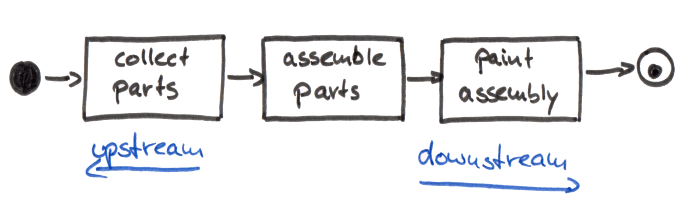
assembly/production line
A assembly/production process is very similar to a river, so it’s easy to grasp that as the process goes from one step to the next, we’re moving downstream.
We can deduct the following rules:
- Dependency Rule: each item depends on all the items upstream from its viewpoint
- Value Rule: moving downstream, each step adds more value to the product
Software Dependencies
Most software components have dependencies to other components. So what’s an upstream dependency and a downstream dependency?
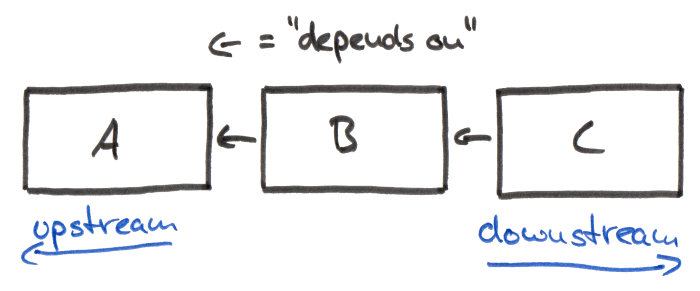
Component C depends on component B which in turn depends on component A.
Applying the Dependency Rule, we can safely say that component A is upstream from component B which is upstream from component C (even though the arrows point in the other direction).
Applying the Value Rule here is a little more abstract, but we can say that component C holds the most value since it “imports” all the features of components B and A and adds its own value to those features, making it the downstream component.
Forking OpenSource Projects
Another context where the words “upstream” and “downstream” are used a lot is in open source development. It’s actually very similar to the component dependencies discussed above.
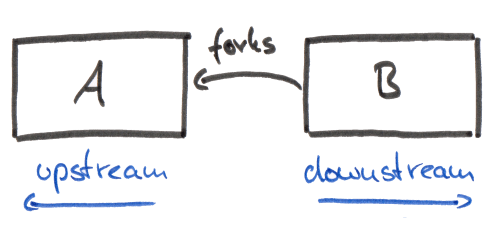
Consider the projects A and B, where A is an original project and B is a fork of A:
This is a rather common development style in open source projects: we create a fork of a project, fix a bug or add a feature in that fork and then submit a patch to the original project.
In this context, the Dependency Rule makes project A the upstream project since it can very well live without project B but project B (the fork) wouldn’t even exist without project A (the original project).
The Value Rule applies as well: since project B adds a new feature or bugfix, it has added value to the original project A.
So, each time we contribute a patch to an open source project we can say that we have sent a patch upstream.
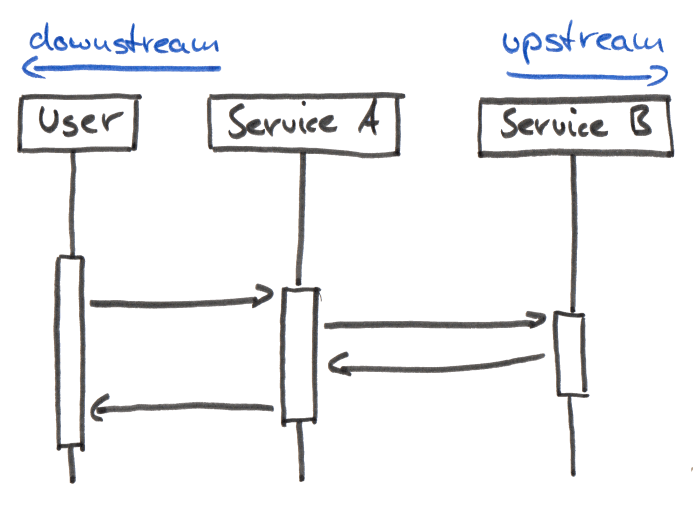
(Micro-)Services
In systems consisting of microservices (or just plain old distributed services for the old-fashioned), there’s also talk about upstream and downstream services.
Unsurprisingly, both the Dependency Rules and the Value Rule also apply to this context.
Service B is the upstream service since service A depends on it. And service A is the downstream service since it adds to the value of service B.
Note that the “stream” defining what is upstream and what is downstream in this case is not the stream of data coming into the system through service A but rather the stream of data from the heart of the system down to the user-facing services.
The closer a service is to the user (or any other end-consumer), the farther downstream it is.