Natural Transformations
- in category theory, a natural transformation provides a way of transforming one functor into another while respecting the internal structure
- just as functors are translators between categories, natural transformations are translators between functors
Natural Transformations - Definitions
If 𝐹 and 𝐺 are functors from the category 𝐶 to 𝐷, then a natural transformation 𝜂 from 𝐹 to 𝐺 is a family of morphisms that satisfies two requirements.
- The natural transformation must associate, to every object 𝑋 in 𝐶, a morphism 𝜂𝑋: 𝐹(𝑋) → 𝐺(𝑋) between objects of 𝐷. The morphism 𝜂𝑋 is called the component of 𝜂 at 𝑋.
- Components must be such that for every morphism 𝑓 : 𝑋 → 𝑌 in 𝐶 we have:
- 𝜂𝑌∘𝐹(𝑓) = 𝐺(𝑓)∘𝜂𝑋
The last equation can conveniently be expressed by the commutative diagram
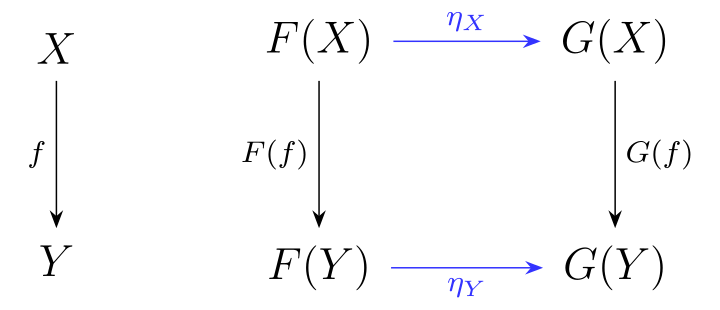
If both 𝐹 and 𝐺 are contravariant, the vertical arrows in the right diagram are reversed. If 𝜂 is a natural transformation from 𝐹 to 𝐺, we also write 𝜂 : 𝐹 → 𝐺 or 𝜂 : 𝐹 ⇒ 𝐺. This is also expressed by saying the family of morphisms 𝜂𝑋: 𝐹(𝑋) → 𝐺(𝑋) is natural in 𝑋.
If, for every object 𝑋 in 𝐶, the morphism 𝜂𝑋 is an isomorphism in 𝐷, then 𝜂 is said to be a natural isomorphism (or sometimes natural equivalence or isomorphism of functors). Two functors 𝐹 and 𝐺 are called naturally isomorphic or simply isomorphic if there exists a natural isomorphism from 𝐹 to 𝐺. Natural isomorphisms are natural translations with inverses.
An infranatural transformation 𝜂 from 𝐹 to 𝐺 is simply a family of morphisms 𝜂𝑋: 𝐹(𝑋) → 𝐺(𝑋), for all 𝑋 in 𝐶. Thus a natural transformation is an infranatural transformation for which 𝜂𝑌∘𝐹(𝑓) = 𝐺(𝑓)∘𝜂𝑋 for every morphism 𝑓 : 𝑋 → 𝑌. The naturalizer of 𝜂, 𝑛𝑎𝑡(𝜂), is the largest subcategory of 𝐶 containing all the objects of 𝐶 on which 𝜂 restricts to a natural transformation.