Introduction Videos
- 3B3B’s Differential Equations
- 3B3B’s Partial Differential Equation
- 3B3B’s Heat Equation
- 3B3B’s Fourier Series
- 3B1B’s e to the power of i pi
ToC
|
| ||||||||
|
|
Fourier Analysis - Comparisons
| |||||||
Fourier-Transform) Algorithms
Link to originalSignal-to-frequency algorithms convert a time-domain signal into its frequency-domain components. They are used to create power spectrums
- is a way of representing a periodic function as a (possibly infinite) sum of sine and cosine functions
- for functions that are not periodic, the Fourier transform is used in place of the Fourier series
- for functions of two variables that are periodic in both variables, the trigonometric basis in the Fourier series is replaced by the spherical harmonics
- is a continuous transformation of a continuous periodic signal
- is analogous to a Taylor series, which represents functions as possibly infinite sums of monomial terms
- cases:
- periodic function → converts into a discrete exponential function or sine and cosine function
- non-periodic function → not applicable
- takes a DISCRETE signal as input and outputs a DISCRETE frequency spectrum
- transforms data in the time or spatial domain into the frequency domain
- should technically be called a Discrete Fourier Series
- is like a Fourier Series on data instead of analytic functions
- converts a finite sequence of equally-spaced samples of a function 𝑓(𝑥) into a same-length sequence of equally-spaced samples of the discrete-time Fourier transform (DTFT), which is a complex-valued function of frequency
- is a unitary, invertible, linear transformation
- most often uses the FFT algorithm to compute the DFT
- is the inverse of the Inverse Discrete Fourier Transform (IDFT)
- takes DISCRETE signal as input and outputs a CONTINUOUS frequency spectrum
- it’s defined by an infinite summation over the discrete-time signal
- while mathematically powerful, the DTFT is not directly computable on a computer because of its continuous nature and infinite summation
- thus Discrete Fourier Transform (DFT) - Discrete Fourier Series is a computationally efficient way to approximate the DTFT
- takes CONTINUOUS time signal as input and outputs a CONTINUOUS frequency spectrum
- is a continuous transformation of a continuous function into its constituent frequencies
- cases:
- periodic function → converts its Fourier series in the frequency domain
- non-periodic function → converts it into a continuous frequency domain
- can ONLY transform nice well-behaved functions that go to 0 at ±∞; otherwise use Laplace Transform
- is a mathematical method that converts a function of a real variable to a function of a complex variable
- a function 𝑓(𝑡) that can’t be Fourier Transformed can be Laplace Transformed by multiplying the function by a decaying exponential 𝑒-𝜁𝑡 and a heavyside function 𝐻(𝑡) where 𝜁 is a constant:
- 𝐹(𝑡) = 𝑓(𝑡)𝑒-𝜁𝑡𝐻(𝑡)
- thus:
- the Laplace transform of 𝑓(𝑡) is the Fourier transform of 𝐹(𝑡)
- the Laplace transform is a one-sided weight Fourier transform
- a discrete version is Z-Transform
- converts a discrete-time signal, which is a sequence of real or complex numbers, into a complex valued frequency-domain representation
- it can be considered a discrete-time equivalent of the Laplace transform
Spectrogram Producing Algorithms
Link to originalCreates a spectrogram by utilizing signal-to-frequency algorithms
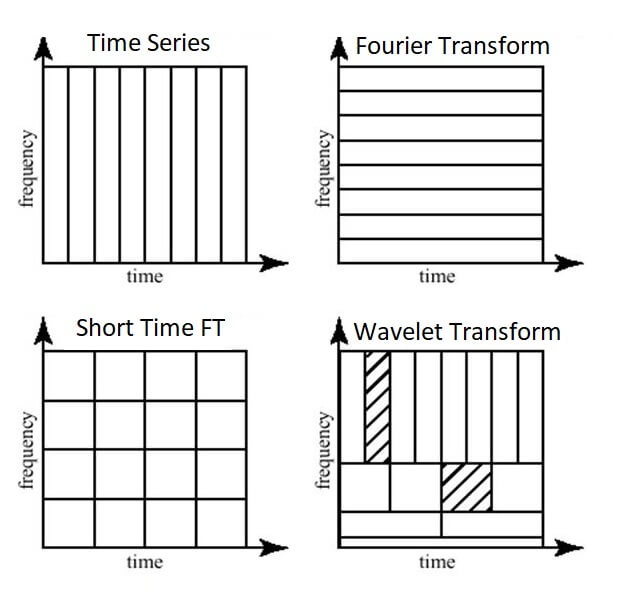
- represents a signal in the time-frequency domain by computing discrete Fourier transforms (DFT) over short overlapping windows
- it is used to compute a spectrogram
- is a special case of the short-time Fourier transform where the window function is a Gaussian function
- the problem Gabor transforms tries to solve is that the Fourier transform takes pure time/spatial data and transforms it into pure frequency data. There’s nowhere in between to look at data in both the time and frequency domain, which is what Gabor Transforms is used for.
- it is used to compute the spectrogram
- it is used to determine the sinusoidal frequency and phase content of local sections of a signal as it changes over time
- generalizes the Fourier transform and is better suited to multi-scale data
- it is like the Gabor Transform but takes advantage of the idea that lower frequencies tend to last for a long time, and higher frequencies tend to change faster in time