information is a subtle mixture of predictability and surprise
Information Theory - Mathematical Theory of Communication
- studies the quantification of information both in storage and communication
- originally proposed by Claude Shannon in 1948 to find fundamental limits on signal processing and communication operations such as data compression, in a landmark paper titled A Mathematical Theory of Communication
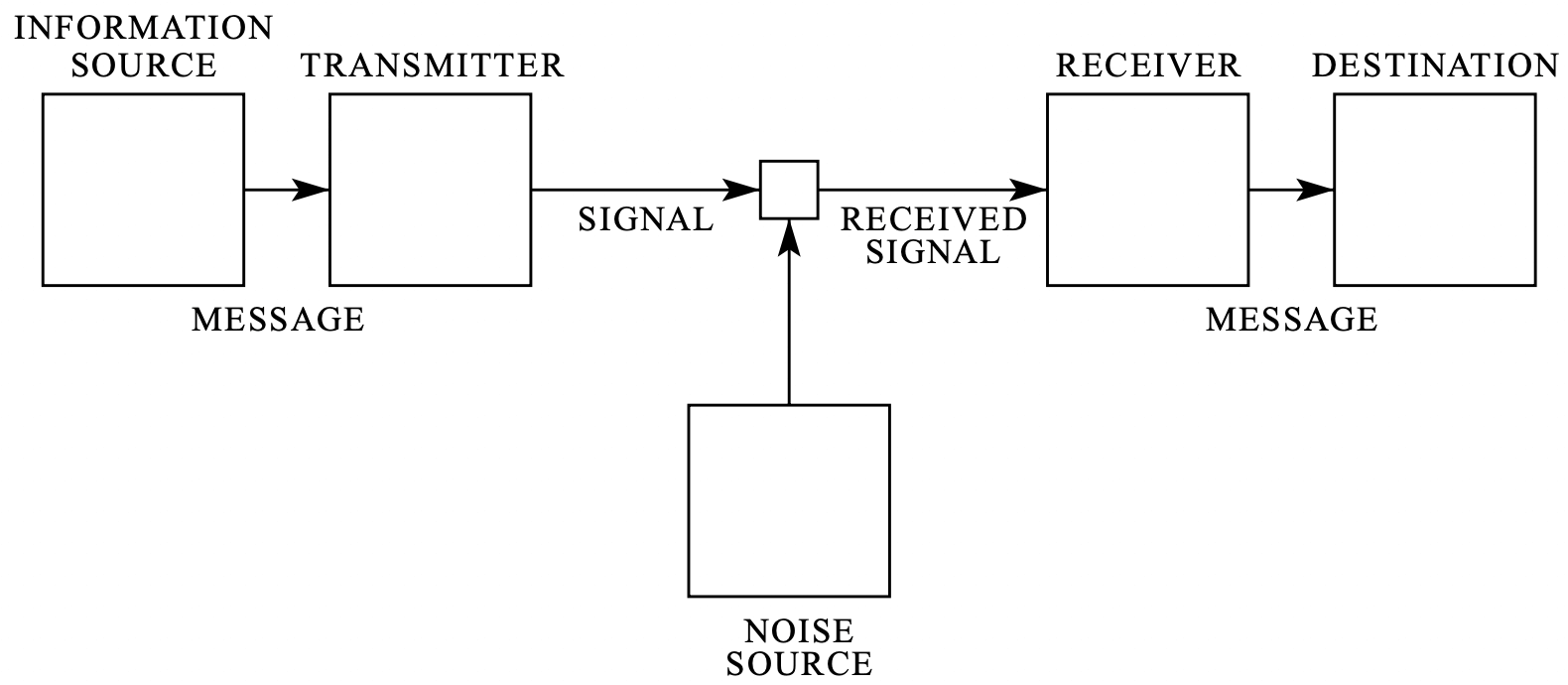
Communication System
|
|
A communication system has 5 components:
|
Communication System - Categories/Classes
Message Type
- discrete message - the message is a sequence of discrete symbols (e.g. sequence of letters)
- continuous message - the message is treated as a continuous function (e.g. voice)
Signal Type
- discrete signal - the signal is a sequence of discrete symbols (e.g. bits in an IP network)
- continuous signal - the signal are treated as continuous functions (e.g. electromagnetic waves, specifically radio waves)
Communication System Type (Message & Signal)
- discrete system - both the message and signal are discrete (e.g. telegraph; messages are sequences of letters, signals are sequences of dots, dashes, and spaces of dots, dashes, and spaces)
- continuous system - both the message and signal are discrete (e.g. radio or television)
- mixed system - message and signal is mixed (e.g. PCM transmission of speech)
Channel Type
- noiseless channel - an idealistic channel in which no information is lost, corrupted, nor duplicated
- noisy channel - a realistic channel in which information can be lost, corrupted, or duplicated
Message Source Statistical
𝑆 is the size of possible symbols such as (letters, words, etc)
- zero-order - each message symbol has an equal probability of being produced
- first-order - 𝑆⁰=1 state - unigrams - each message symbol has
- second-order - 𝑆¹ states - bigrams -
- third-order - 𝑆² states - trigrams -
- nth-order - 𝑆𝑛 states - n-grams -
Subpages
- Quantum Information Theory
List indent undo
- Conditional Relative Entropy
- Fisher Information - Fisher Information Matrix
- Mathematical Capacity of a Communications Channel
- Multivariate Entropy (Joint Entropy - Conditional Entropy - (Pointwise) Mutual Information / Information Gain - Variation of Information)
- Source Coding Theorem
- Telegraph/Telegraphy
- Teletype (TTY)
- Univariate Entropy (Information Content - Entropy - Cross Entropy - KL Divergence)