- wiki - evidence of common descent
- https://evolutionnews.org/2019/04/despite-dozens-of-authors-pnas-paper-fails-to-explain-bird-evolution/
the organisms you see today are here because of 2 main processes:
- replicate
- survive
Types of Evolution
- micro-evolution - small-scale evolution (changes in allele)
- macro-evolution - large-scale evolution (the descent of different species from a common ancestor over many generations)
Phylogenetic Tree (Family Tree)
-
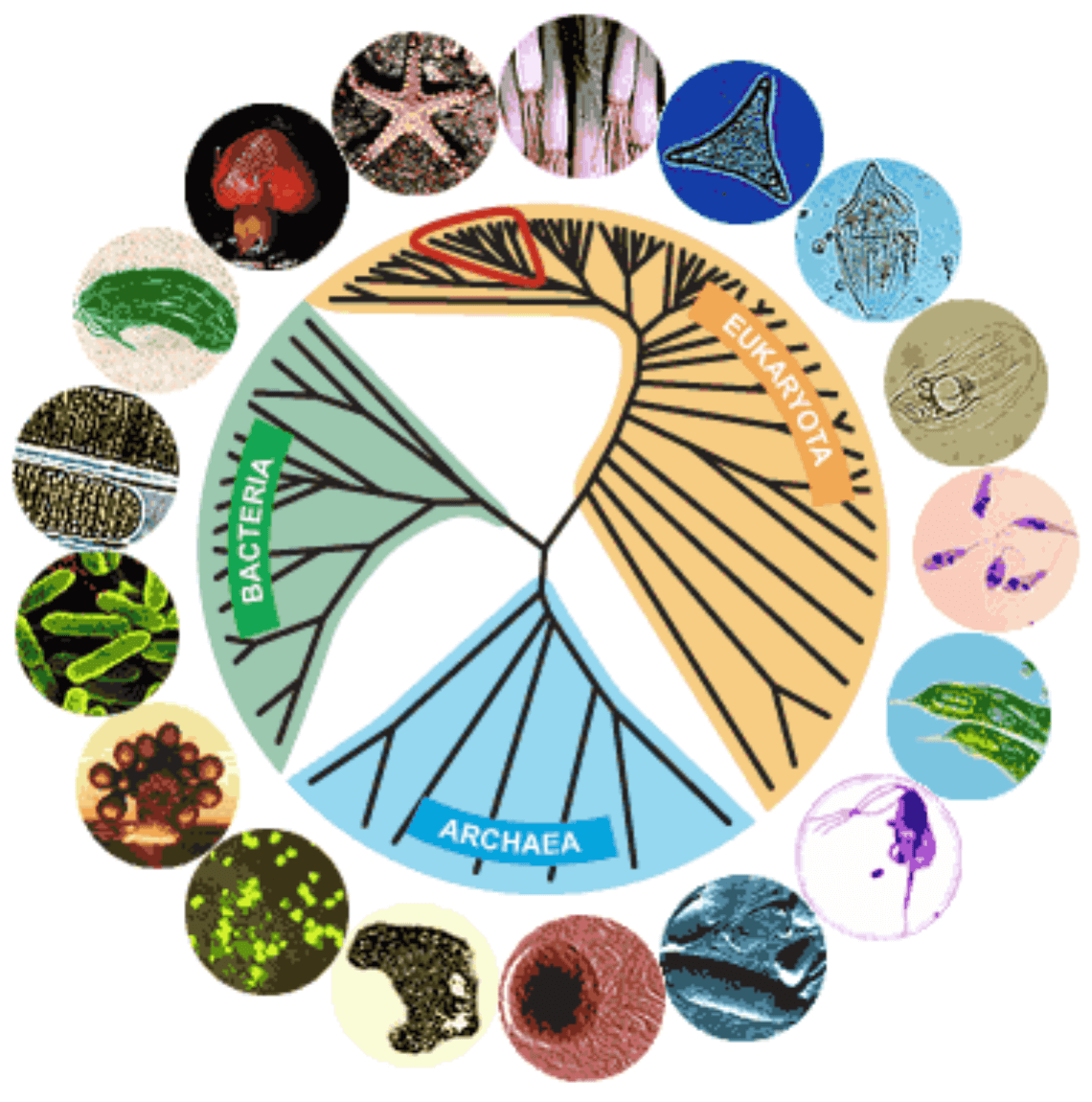
phylogenetic trees is a hypothesis about the relationships among organisms
-
phylogenetic tree can be divided into 3 major clades (domains):
- archaea
- bacteria
- eukaryota
List indent undo
Building The Tree
- to build a phylogenetic tree such as the one to the right, biologists collect data about the characteristics of each organism they are interested in (one critique I have is that similar characteristics does not mean common ancestor)
- homologous characters - characters in different organisms that are similar because they were inherited from a common ancestor that also had that character
- analogous characters - characters that are superficially similar but have separate evolutionary origins
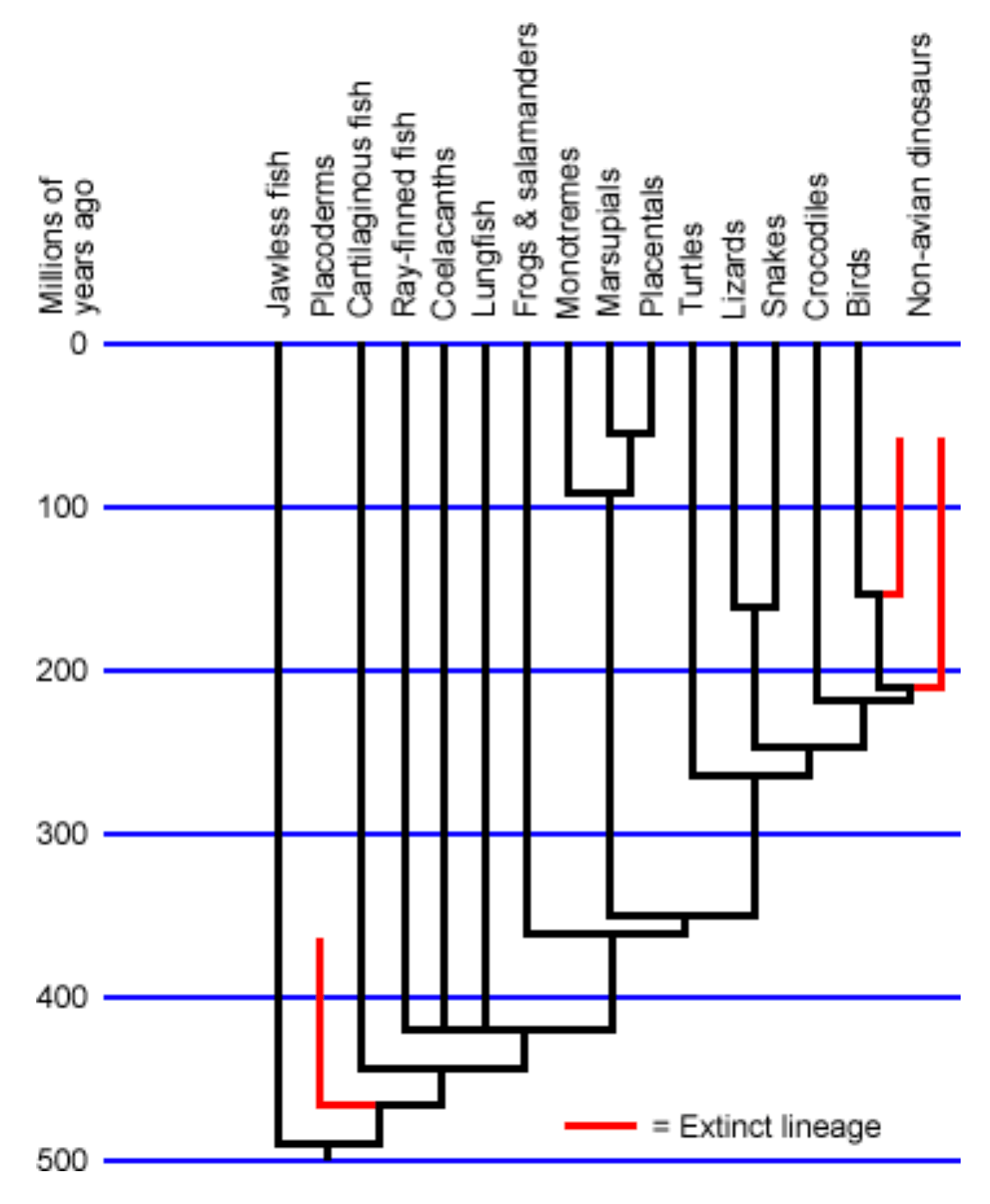
Adding Time to The Tree
The Processes of Evolution
processes of evolution:
- evolution - descent with modification from a common ancestor
- mechanisms of change -
- sources of genetic variation -
- coevolution - how different species affect each other’s evolution
Descent with Modification
evolution is descent with modification from a common ancestor, but what is being modified? The change is in gene frequency within a population over time.
Mechanisms of Change:
- mutation - a change in a DNA sequence, usually because of errors in replication or repair, or by external factors
- migration (gene flow) - is any movement of genes from one population to another
- genetic drift - variation in the relative frequency of different genotypes in a small population, owing to the chancedisappearance of particular genes as individuals die or do not reproduce
- natural selection - the process whereby organisms better adapted to their environment tend to survive and produce more offspring
All of these mechanisms can cause changes in the frequencies of genes in populations, and so all of them are mechanisms of evolutionary change. However, natural selection and genetic drift cannot operate unless there is genetic variation — that is, unless some individuals are genetically different from others. If the population of beetles were 100% green, selection and drift would not have any effect because their genetic make-up could not change
Sources of Genetic Variation
there are 3 primary sources of genetic variation:
- mutations - a change in a DNA sequence, usually because of errors in replication or repair, or by external factors
- migration (gene flow) - is any movement of genes from one population to another
- sex - allows genetic shuffling
Development
- development - is the process through which an embryo becomes an adult organism and eventually dies
- limiting evolutionary change - developmental processes may constrain evolution, preventing certain characters from evolving in certain lineages
Fitness
- fitness - describes how good a particular genotype is at leaving offspring in the next generation relative to how good other genotypes are at it
Sexual Selection
- is a “special case” of natural selection
- acts on an organism’s ability to obtain or copulate with a mate
- often powerful enough to produce features that are harmful to the individual’s survival. For example, extravagant and colorful tail feathers or fins are likely to attract predators as well as interested members of the opposite sex
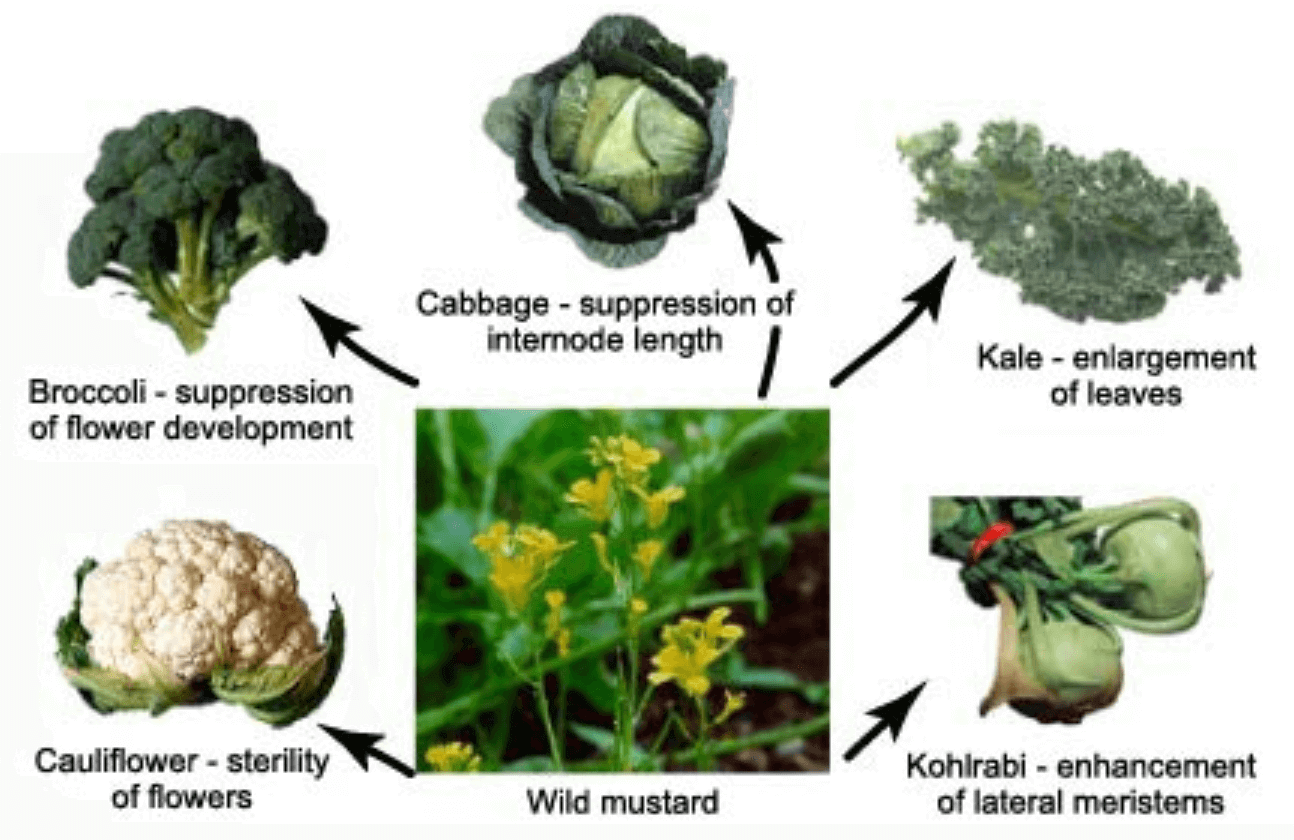
Artificial Selection
- people (instead of nature) select which organisms get to reproduce
List indent undo
Adaptation
- adaptation - is a feature that is common in a population because it provides some improved function. Adaptations are well fitted to their function and are produced by natural selection.
- adaptations can take many forms:
- a behavior that allows better evasion of predators
- a protein that functions better at body temperature
- an anatomical feature that allows the organism to access a valuable new resource
Natural Selection
- natural selection is the simple result of:
- variation - differences in genomes
- differential reproduction - how many offspring each group of individuals is able to leave behind
- heredity - passing of genomes from one generation to another
- natural selection acts on genetic variation in a non-random way: genetic variants that aid survival and reproduction are much more likely to become common than variants that don’t
Coevolution
- coevolution is likely to happen when different species have close ecological interactions with one another. These ecological relationships include:
- predator/prey and parasite/host
- competitive species
- mutualistic species
Species and Speciation
- species - is often defined as a group of individuals that actually or potentially interbreed in nature. But that is not always the case in nature
- speciation - the formation of new and distinct species in the course of evolution
Big Questions:
- Does evolution tend to proceed slowly and steadily or in quick jumps?
- Why are some clades very diverse and some unusually sparse?
- How does evolution produce new and complex features?
- Are there trends in evolution, and if so, what processes generate them?