Photosynthesis is the process in which light energy is converted to chemical energy
6CO₂ + 6H₂O + photons --------------> C₆H₁₂O₆ + 6O₂carbon water solar photosynthesis glucose oxygendioxide energy
photoautotrophs (self-feeders that use light) - are organisms that use light to produce their own energy
heterotrophs (different-feeders) - organisms that can’t convert carbon dioxide to organic compounds
Sections
- green leaves structure
- light-dependent & light-independent reactions
Green Leaves Structure
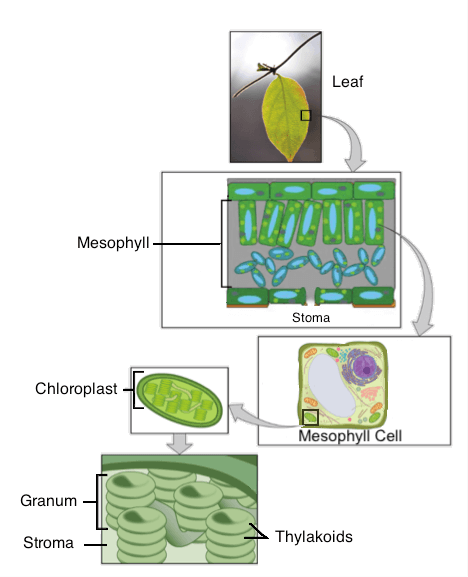
mesophyll - are cells in the middle layer of tissue
stomata (stoma singular) - small pores found on surface of leaves that allow carbon dioxide to diffuse into mesophyll layer and oxygen to diffuse out
chloroplasts - are organelles within mesophyll cells
thylakoids - are disc-like structures within a chloroplast
grana (granum singular) - are stacks of thylakoids
stroma - are the fluid space around the grana
thylakoid space - is the space inside the thylakoid disks
Light-Dependent and Light-Independent Reactions
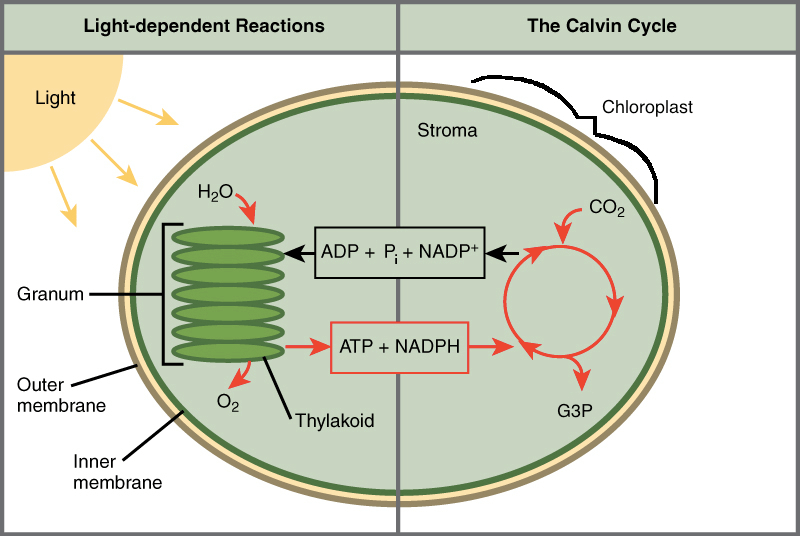
photosynthesis can be divided into 2 stages:
- light-dependent reactions
- requires continuous supply of light energy
- take place in thylakoid membrane
- chlorophyll converts light energy to chemical energy, through formation of:
- ATP - an energy storage molecule
- NADPH - a reduced (electron-bearing) electron carrier
- this turns water molecules into oxygen
- light-independent reactions (Calvin Cycle)
- does not require light
- takes place in the stroma
- uses ATP, NADPH, and carbon dioxide to produce 3-carbon sugars (glyceraldehyde-3-phosphate or G3P)
- G3P are joined up to produce glucose
Overall, the light-dependent reactions capture light energy and store it temporarily in the chemical forms of ATP and NADPH. There, ATP is broken down to release energy, and NADPH donates its electrons to convert carbon dioxide molecules into sugars. In the end, the energy that started out as light winds up trapped in the bonds of the sugars.