used to measure the atomic weight of an element
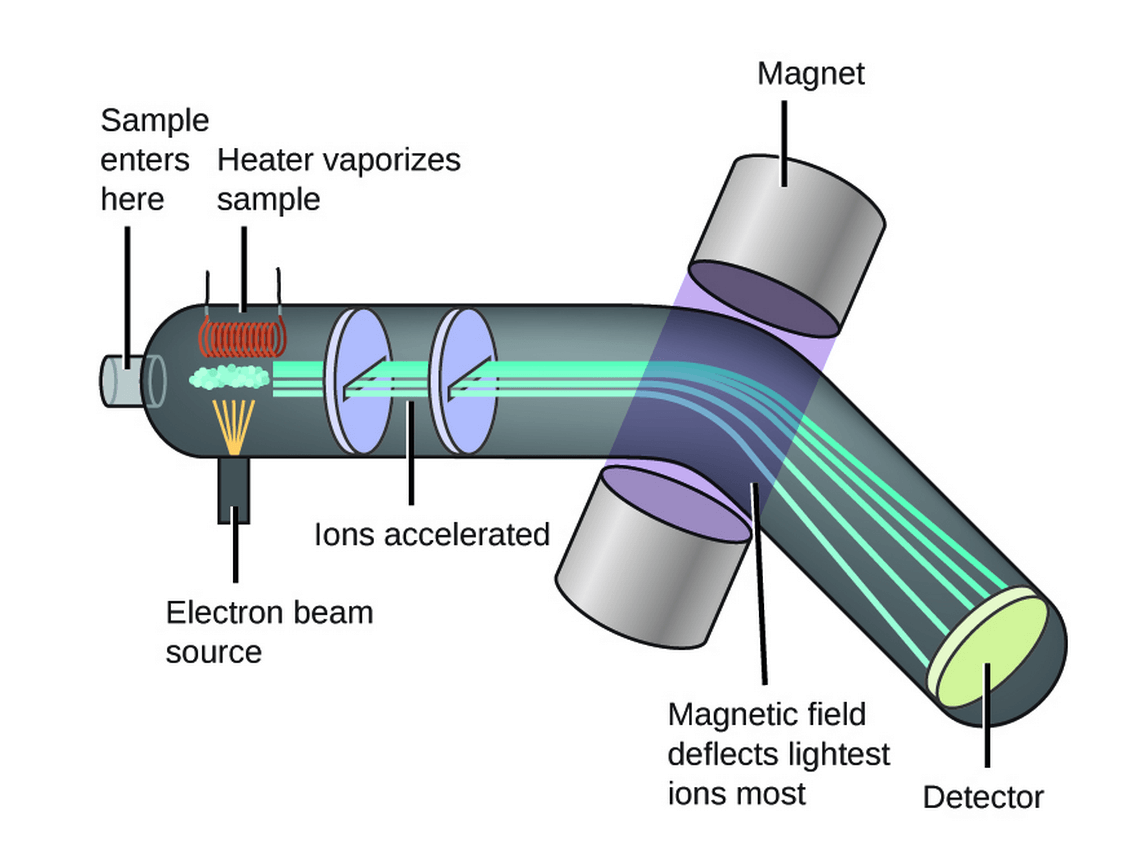
In a mass spectrometer, a sample containing the atoms or molecules of interest is injected into the instrument. The sample—typically in an aqueous or organic solution—is immediately vaporized by a heater, and the vaporized sample is then bombarded by high-energy electrons. These electrons are powerful enough to knock electrons off atoms in the sample, which creates cationic versions of the sample. These cations are then accelerated through electric plates and subsequently deflected by a magnetic field.
Once the ions reach the magnetic field, they are deflected different amounts depending on their speed and charge. Ions that are moving more slowly, the heavier ions, are deflected less, and ions that are moving more quickly, the lighter ions, are deflected more. Think of the force you need to apply to accelerate a bowling ball versus the force necessary to accelerate a tennis ball. It’s much easier to accelerate the tennis ball! Also, the higher the charge on the ion, the more it will be deflected.
The amount that the ions are deflected is inversely proportional to their mass-to-charge ratio, m/z, where mmm is equal to the mass of the ion and z is equal to the charge. The detector records the m/z values for each ion, as well how many of each ion it sees. The relative abundance for a specific ion within the sample can be calculated by dividing by the number of ions of that type by the total number of ions detected. The instrument then generates a mass spectrum for the sample, which plots relative abundance against the mass-to-charge ratio, m/z.