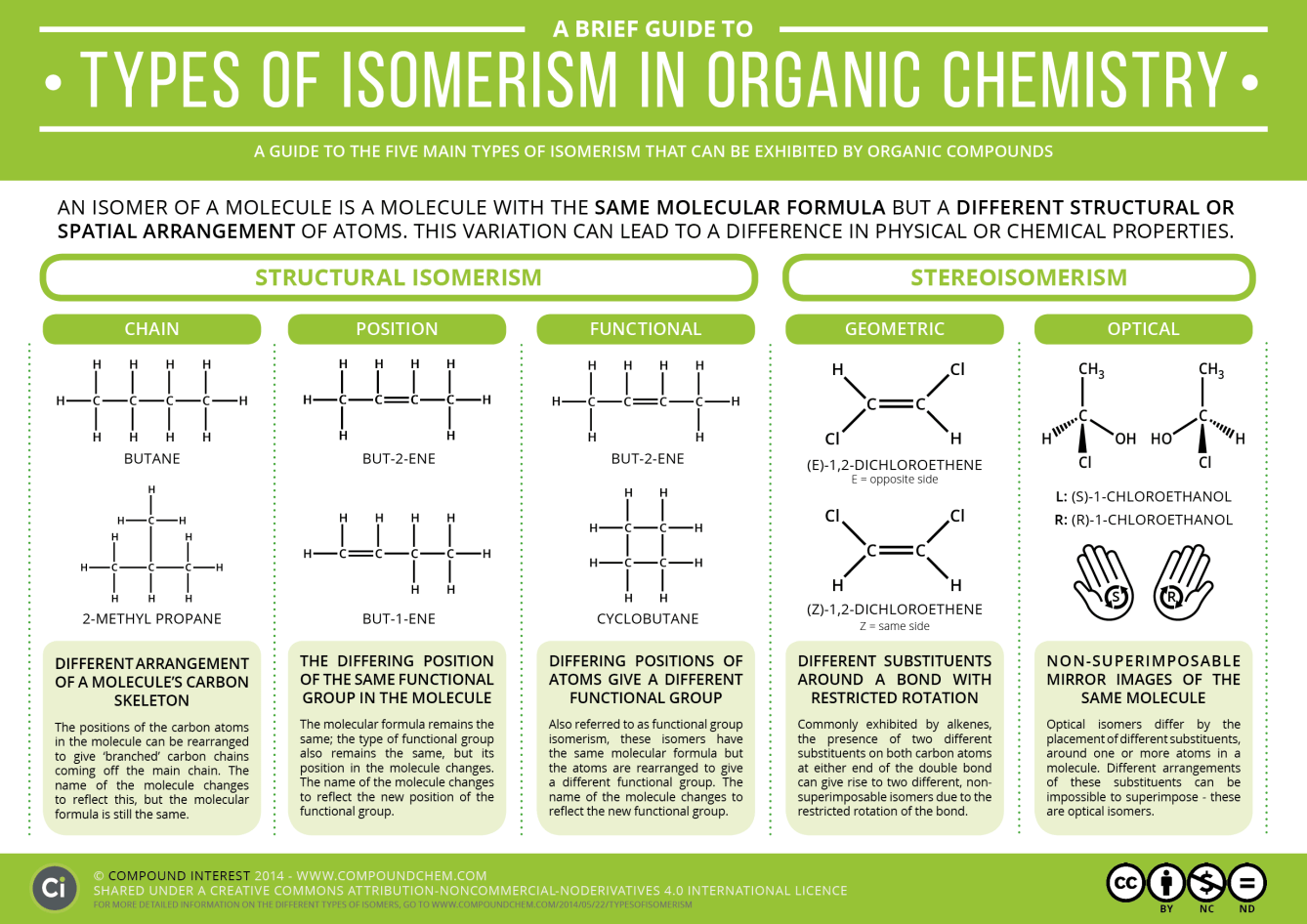
an isomer of a compound is a molecule/compound with the same chemical/molecular formula but a different structural or spatial arrangement of atoms. this variation can lead to a difference in physical or chemical properties
Types of Isomers
- structural isomers - the atoms in each isomer are connected, or bonded, in different ways
- chain
- position
- functional
- stereoisomers - the atoms in each isomer are connected in the same way but differ in how they are oriented in space
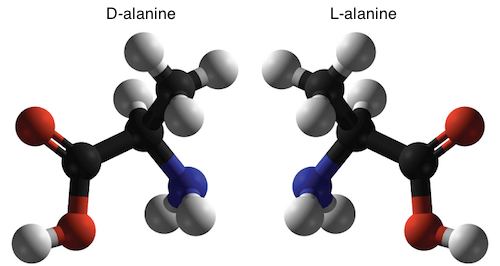
- enantiomers - are stereoisomers that are non-superimposable mirror images of each other
- diastereomers - are stereoisomers that are not enantiomers
- cis-tran isomers - atoms or functional groups are situated on either end of a rigid carbon-carbon bond (double or triple bond)
Enantiomers / Optical Isomers
Historically, enantiomers in biology were distinguished using the prefixes L and D, and biologists often still use this terminology for amino acids and sugars. However, in the wider world of chemistry, the D/L system has been replaced by another naming system, the R/S system, which is more precise and can be applied to all enantiomers. You can learn more about enantiomers and the R/S naming system in the organic chemistry section
Cis-transIsomers / Geometric Isomers

For example, in 2-butene H8C4, the two methyl groups CH3 can occupy different positions relative to the double bond central to the molecule. If the methyl groups are on the same side of the double bond, this is called the cis configuration of 2-butene; if they are on opposite sides, this is the trans configuration.
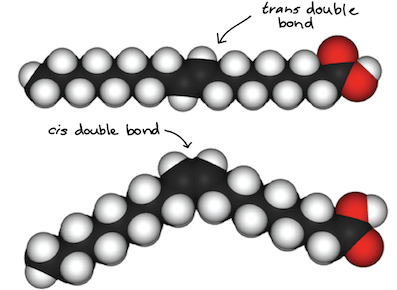
In the trans configuration, the carbon backbone is more or less linear, whereas in the cis configuration, the backbone contains a bend, or kink. (Some ring-shaped molecules can also have cis and trans configurations, in which attached atoms are trapped on the same or on opposite sides of the ring, respectively)
In fats and oils, long carbon chains called fatty acids often contain double bonds, which can be in either the cis or trans configuration (shown below). Fatty acids that contain cis double bonds are typically oils at room temperature. This is because the bends in the backbone caused by cis double bonds prevent the fatty acids from packing tightly together. In contrast, fatty acids with trans double bonds (popularly called trans fats), are relatively linear, so they can pack tightly together at room temperature and form solid fats.
Trans fats are linked to an increased risk of cardiovascular disease, so many food manufacturers have eliminated their use in recent years. Fats with trans double bonds are found in some types of shortening and margarine, while fats with cis double bonds may be found in oils, such as olive oil and canola oil. See the article on lipids to learn more about the different types of fats.