Covectors are functions 𝛼: 𝑉→ℝ that map a vector to a number and also obey the following rules:
- 𝛼(𝑣 + 𝑢) = 𝛼(𝑣) + 𝛼(𝑢)
- 𝛼(𝑛·𝑣) = 𝑛·𝛼(𝑣)
Covectors can also be viewed as elements of dual vector space 𝑉*:
- (𝑛·𝛼)(𝑣) = 𝑛·𝛼(𝑣)
- (𝛼+𝛽)(𝑣) = 𝛼(𝑣) + 𝛽(𝑣)
Covectors can be visualized as level sets
What does a covector measure when we write [2 1]? like 2 of what and 1 of what?
Covectors don’t live in the vector space 𝑉, thus we can’t use basis vectors in 𝑉 like {𝑒1, 𝑒2} to measure covectors
|
epsilon covectors 𝜀𝑖 are defined as:
Thus:
|
In other words, let:
The system of equations can be expressed as: |
|
epsilon covector 𝜀𝑖 consumes arbitrary vector 𝑣: | |
|
|
|
arbitrary covector 𝛼 consumes arbitrary vector 𝑣:
Thus
Thus
|
|
The epsilon covectors 𝜀1 and 𝜀2 form the basis vectors of the dual vector space 𝑉*:
|
|
The components of covector 𝛼 can be extracted as follows:
Thus:
|
|
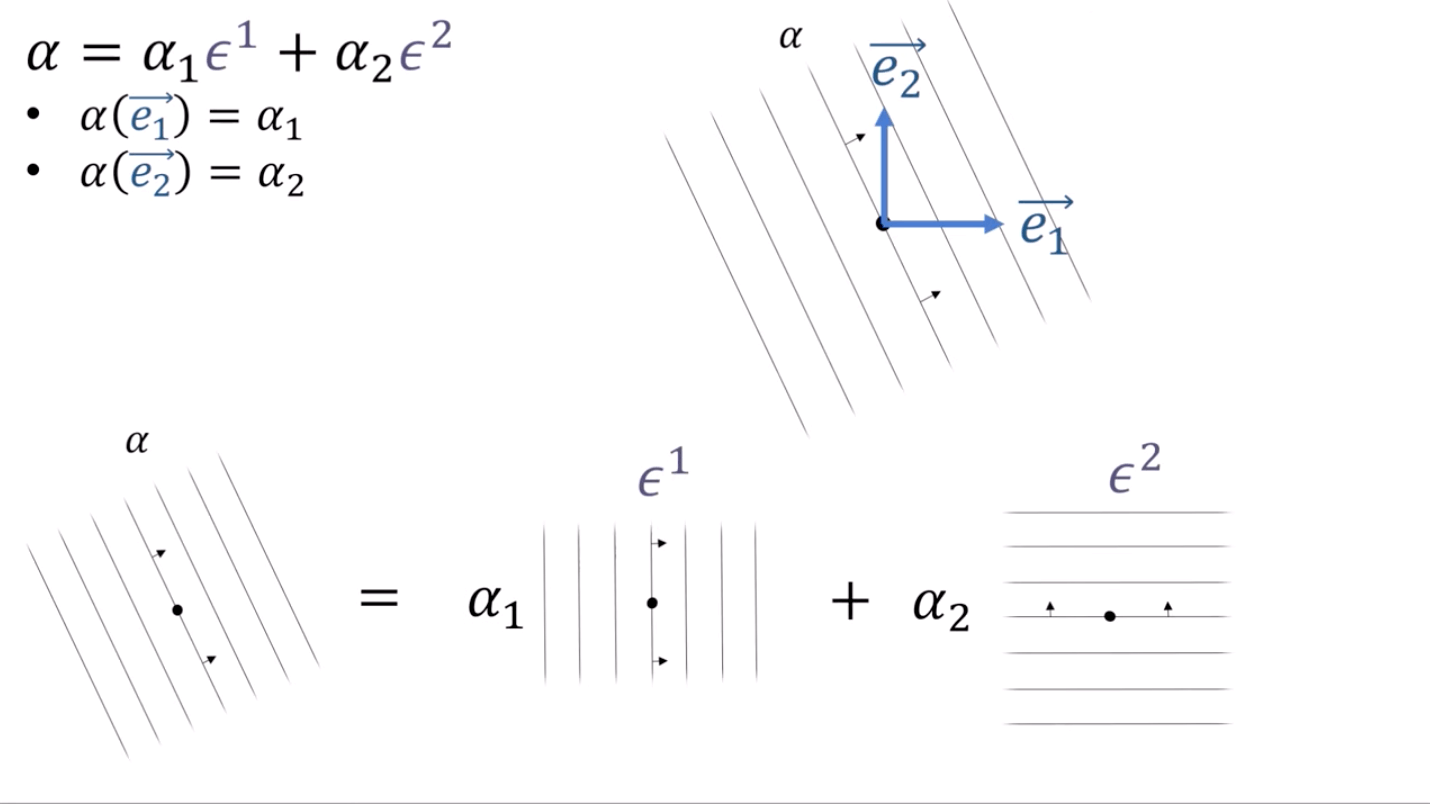
RECAP:
- starting with basis vectors 𝑒𝑖 of a vector space 𝑉
- you can derive the epsilon covectors 𝜀𝑖 as so: 𝜀𝑖(𝑒𝑗) = 𝛿𝑖𝑗
- in which the epsilon covectors form a dual basis of the dual vector space 𝑉*