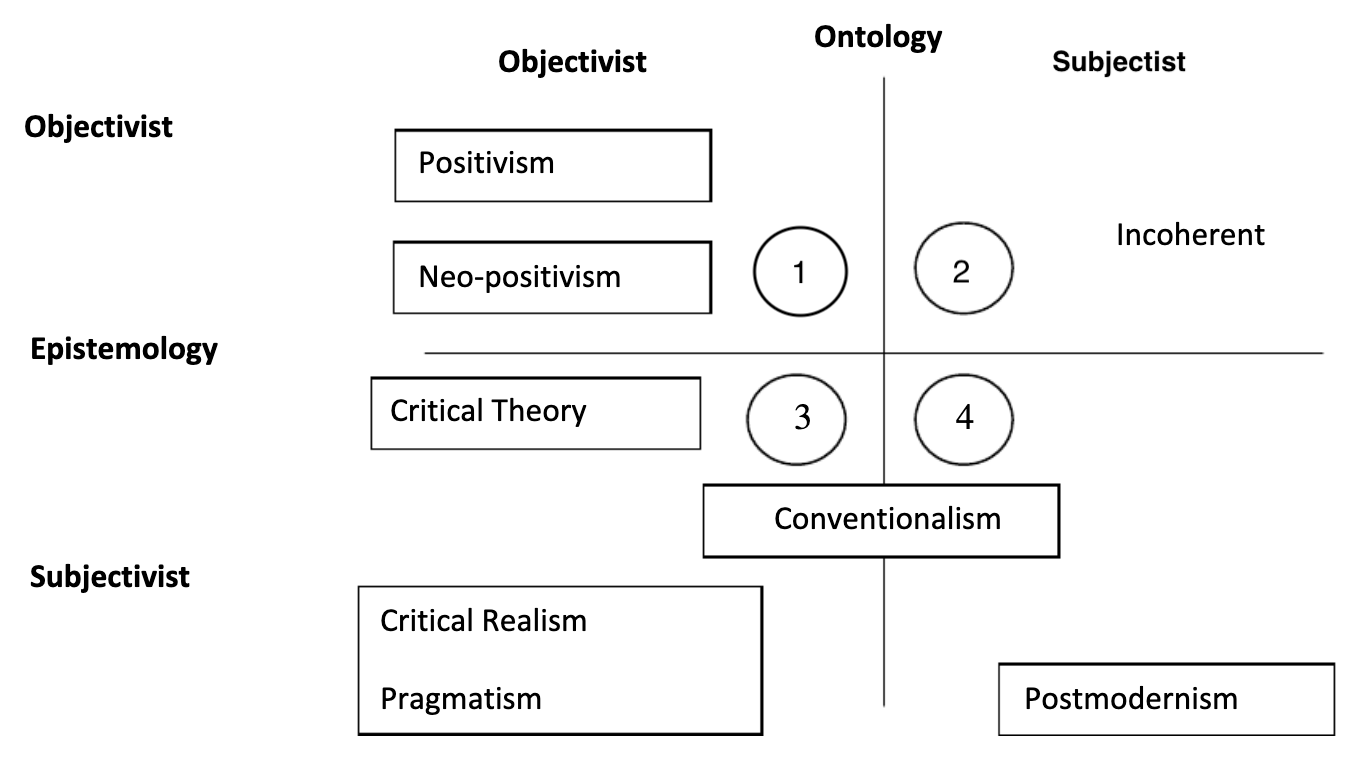
a philosophical system is a belief (or system of beliefs) accepted as authoritative by some group or school
Brief Synopsis
Epistemology - Objectivist vs Subjectivist vs Constructivist
- objectivist epistemology - there is an external, universal reality that can be known by breaking it down into fragments and studying each one separately. In this case the knower is completely detached from the actual knowledge
- subjectivist epistemology - knowledge is internally constructed and therefore completely subjective. It depends on the context and should also focus on its holistic nature. The knower cannot be separated from what is known
Ontology - Objectivist vs Subjectivist
- objectivist ontology - the doctrine that universals or abstract concepts have an objective or absolute existence. The theory that universals have their own reality is sometimes called Platonic realism because it was first outlined by Plato’s doctrine of “forms” or ideas
- subjectivist ontology - the doctrine that universals or general ideas are mere names without any corresponding reality, and that only particular objects exist; properties, numbers, and sets are thought of as merely features of the way of considering the things that exist
Philosophical Systems
Objectivist Ontology & Objectivist Epistemology (Area 1)
- this area presupposes theory of neutral observational language
- positivism -
- neo-positivism -
- logical positivism/empiricism -
Subjectivist Ontology & Objectivist Epistemology (Area 2)
- Incoherent
Objectivist Ontology & Subjectivist Epistemology (Area 3)
- this area rejects the theory of neutral observational language
- critical theory -
- critical realism -
- pragmatism -
Subjectivist Ontology & Subjectivist Epistemology (Area 4)
- this area rejects the theory of neutral observational language
- postmodernism -
Mixed
- conventionalism -
Philosophical Systems - Diagram