Epistemology - Objectivist vs Subjectivist
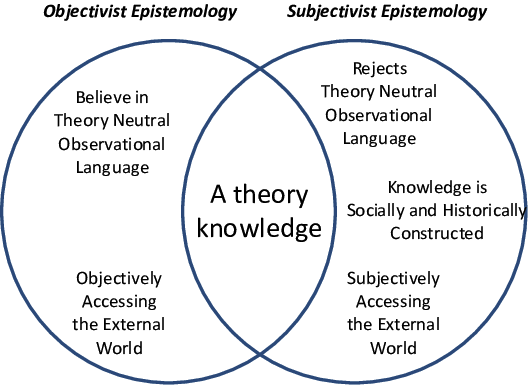
- objectivist/positivist/empiricist epistemology
- there is an external, universal reality that can be known by breaking it down into fragments and studying each one separately. In this case the knower is completely detached from the actual knowledge. This position has evolved into post-positivism where it is granted that the knower is in a cultural context but still emphasizes that one can arrive to an objective reality
- accepts Theory-Neutral Observations
- objectively accessing the external world
- subjectivist/interpretivism/relativism epistemology
- knowledge is internally constructed and therefore completely subjective. It depends on the context and should also focus on its holistic nature. The knower cannot be separated from what is known
- rejects Theory-Neutral Observations
- subjectively accessing the external world
- knowledge is socially and historically constructed
Epistemology can also look at knowledge from another perspective however which is found mid-way between the other two while introducing another dimension:
- constructivist epistemology
- knowledge about the human world is different from knowledge about the physical world. It is socially constructed, always belonging to a particular context. The reality experienced is only constructed but is experienced as real by the people concerned.
Methodology (Epistemology with Ontology)
Methodology - Philosophical Systems
Diagram