Page Sections
- theories of acids and bases
- Acids & Bases - pH - Buffers
- Acids & Bases - pH - Buffers
Svante Arrhenius Definition of Acids/Bases
acid - a compound that increases concentration of H+/protons when in aqueous solution (or H3O/hydronium when H+ bonds with H2O)
base - a compound that increases concentration of OH-/hydroxide when in aqueous solution
example strong acid - HCl
HCl(aq) + H2O(l) -> H+(aq) + CL-(aq)
example strong base - NaOH
NaOH(aq) + H2O(l) -> Na+(aq) + OH-(aq)
Brønsted-Lowry Definition of Acids/Bases
acid - H+/proton donor
base - H+/proton acceptor
example strong acid - HCl
HCl(aq) + H2O(l) -> H+(aq) + CL-(aq)
example strong base - NaOH
NaOH(aq) + H2O(l) -> Na+(aq) + OH-(aq)
Lewis Definition of Acids/Bases
TODO - article
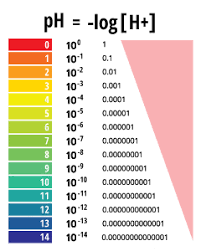
pH Definition
pH = -log(hydrogen protons concentration)
pH = -log(hydronium concentration)
Buffers
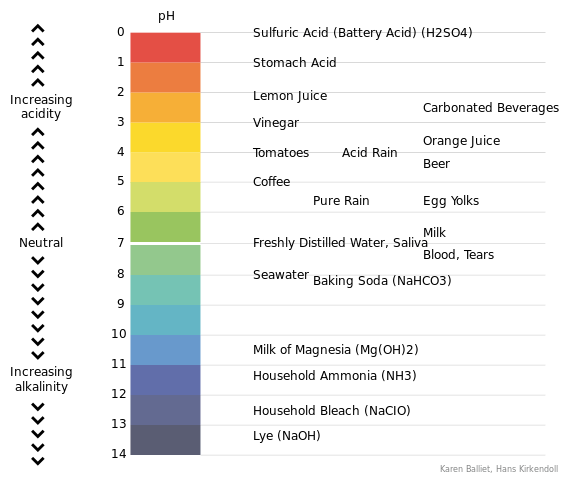
Most organisms, including humans, need to maintain pH within a fairly narrow range in order to survive. For instance, human blood needs to keep its pH right around 7.4
Buffers - solutions that can resist changes in pH, are key to maintaining stable H+ ion concentrations in biological systems.
- when there are too many H+ ions, a buffer will absorb some of them, bringing pH back up
- when there are too few H+ ions, a buffer will donate some of its own H+ions to reduce the pH
Buffers typically consist of an acid-base pair, with the acid and base differing by the presence or absence of a proton (a conjugate acid-base pair). For instance, one of the buffers that maintain the pH of human blood involves carbonic acid (H2CO3) and its conjugate base, the bicarbonate ion (HCO3-).

- if too many H+ ions build up, the equation above will be pushed to the right, and bicarbonate ions will absorb the H+ to form carbonic acid
- if H+ concentrations drop too low, the equation will be pulled the left and carbonic acid will turn into bicarbonate, donating H+ ions to the solution