Language Components
every language contains a lexicon, a set of phonemes, and a grammar that acts on these sets
- lexicon/vocabulary - the sum total of all the lexemes (all possible combinations of word-stems and affixes in a language)
- lexeme - is the set of inflected forms of a single lemma (inflectional morphemes applied to the single word) a set of lexical forms having the same stem, the same part of speech, and the same word sense
- lexeme (word sense) - refers to a particular meaning of a particular lexeme
- lemma or word stem
- lexeme vs lemma example:
- run, runs, ran and running are inflectional forms of the same lemma run
- the word runner (a derived term—it has a derivational morpheme attached) does not belong to the same lexeme run
- set of phonemes - auditory representations of words
- set of graphemes and diacritics - visual written representations of words
- set of signed language - visual gesture representations of words
- grammar - is a set of rules a language obeys for creating words and sentences (i.e. morphology and syntax)
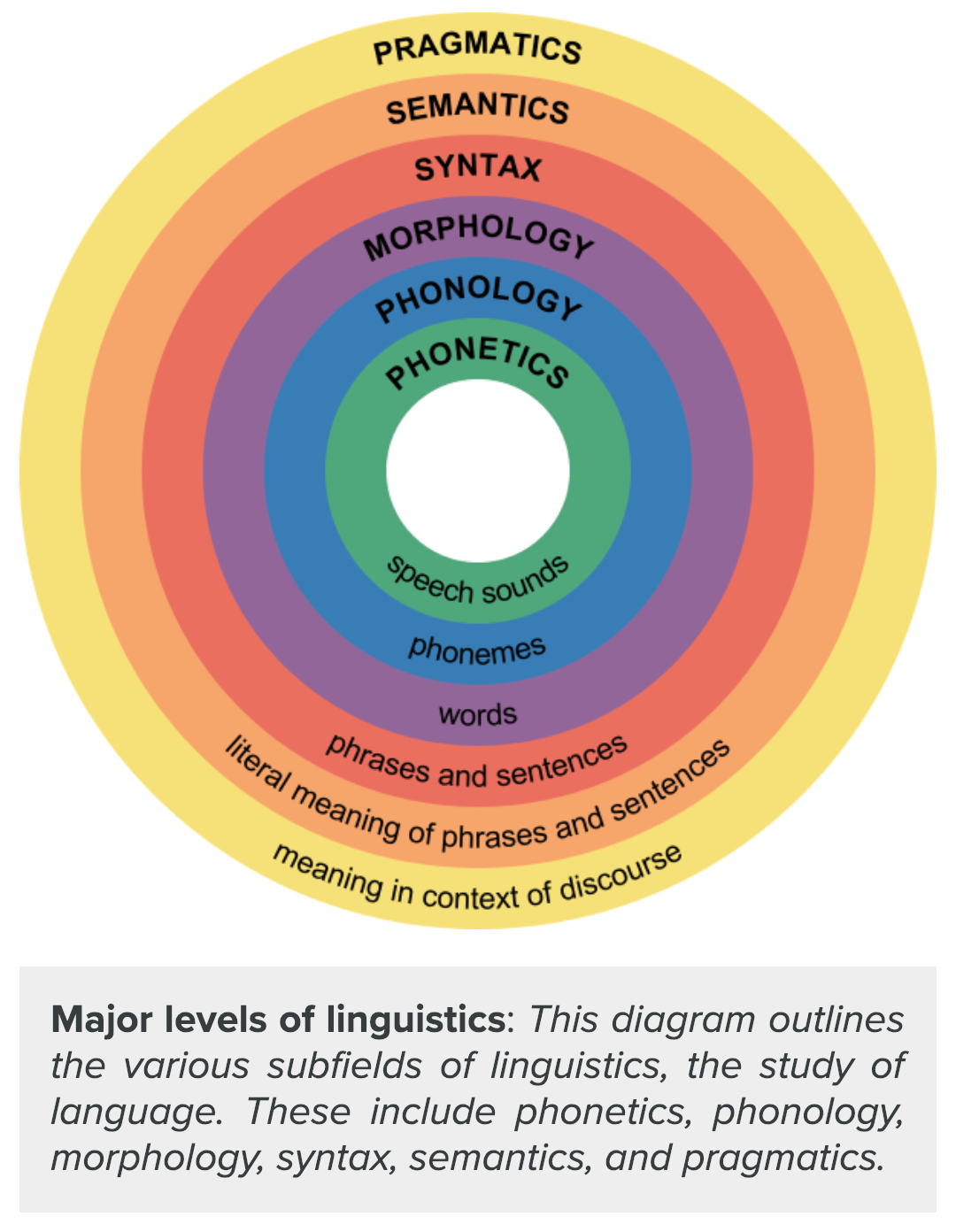
Levels of Linguistics
Ways of Transceiving language
- Visual Written Language (Graphemes - Diacritics)
- Visual/Motor Signed Language
- Auditory Speech Sounds (Prosody - Phonetics - Phonology)
Link to original- prosody is concerned with the suprasegmentals (properties) of syllables and larger units of speech (e.g. stress, length, intonation, syllabification, tone, etc)
- phonetics and phonology are heavily overlapping subfields cover all the sounds that humans can make, as well as which sounds make up different languages
- phonetics is the study of phones, which are speech sounds detached from language
- the study of the description and classification of speech sounds (phonemes)
- how sounds are produced, transmitted and received
- independent to language
- phonology is the study of phonemes, which are the speech sounds attached to an individual language
- the study of the speech sounds used in a particular language. including the differences and similarities of speech sounds (phonemes) sets of languages
- dependent to language
Link to originalGrammar = Morphology + Part of Speech + Syntax (Rules) - the rules of morphology and syntax produces grammar. it is a set of linguistic habits that is constantly being negotiated and reinvented
- morphology
- the study of morphemes and word inflexions/forms
- a morphologist would be interested in the relationship between words like “dog” and “dogs” or “walk” and “walking,” and how people figure out the differences between those words
- lexical grammar describes the structure of the lexicon, that is, every token (word) used in the language
- syntactical grammar describes how phrases and documents are formed from those tokens
- part of speech
- is a category to which a word is assigned in accordance with its syntactic functions
- syntax
- is the set of rules, principles, and processes that govern the structure of sentences/phrases
- is a set of rules for constructing full sentences/phrases out of lexemes
- is the study of sentences/phrases structure, or how people put words into the right order so that they can communicate meaningfully
- all languages have underlying rules of syntax, which, along with morphological rules, make up every language’s grammar. An example of syntax coming into play in language is “Eugene walked the dog” versus “The dog walked Eugene.” The order of words is not arbitrary—in order for the sentence to convey the intended meaning, the words must be in a certain order
Meaning = Semantics + Pragmatics + Discoursology
Link to original
- discoursology
Link to original
- how the meaning of words and sentences is affected by the proceeding/surrounding sentences (e.g. pronoun coreference resolution)
- semantics
Link to original
- is about taking words & sentences and assigning meaning to them (without environmental-context)
- is the study of the meaning of phonemes, morphemes, lexemes, phrases, and sentences (syntax)
- pragmatics
- is the study of sentence meaning with environmental context (goals and intentions of the speaker) includes: prosody, body language, etc
- is an even broader field that studies how the environmental context of a sentence contributes to meaning—for example, someone shouting “Fire!” has a very different meaning if they are in charge of a seven-gun salute than it does if they are sitting in a crowded movie theater.
- perspectives
- a basic problem is that if John says
This is funand Mary saysThis is not fun, it’s possible for both sentences simultaneously to be true (relative to their respective speakers), but we also want to claim that John and Mary are overtly contradicting or disagreeing with each other- hermeneutics - specifically deals with the interpretation of literary texts