Sections
Introduction
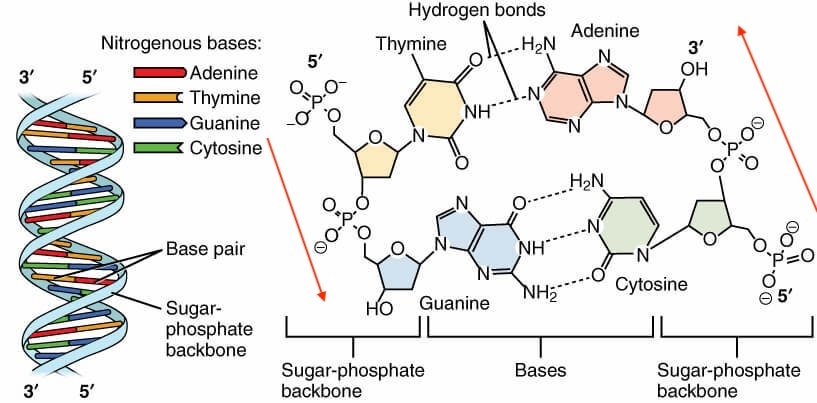
polynucleotide chain has directionality:
- at the 5’ end, or beginning, of the chain, the 5’ phosphate group of the first nucleotide in the chain sticks out
- at the other end, called the 3’ end, the 3’ hydroxyl of the last nucleotide added to the chain is exposed
as new nucleotides are added to a strand of DNA or RNA, the strand grows at its 3’ end, with the 5′ phosphate of an incoming nucleotide attaching to the hydroxyl group at the 3’ end of the chain. This makes a chain with each sugar joined to its neighbors by a set of bonds called a phosphodiester linkage
Deoxyribonucleic Acid (DNA)
 e
e
Ribonucleic Acid (RNA)
four major types of RNA:
ribosome
- is a molecular machine that specializes in assembling proteins out of amino acids
- uses the information in the mRNA to make a protein of a specific sequence:
- “reading out” the mRNA’s nucleotides in groups of three (called codons)
- adding a particular amino acid for each codon
Messenger RNA (mRNA)
mRNA is a form of RNA in which genetic information transcribed from DNA as a sequence of bases is transferred to a ribosome
Ribosomal RNA (rRNA)
rRNA is a major component of ribosomes, where it helps mRNA bind in the right spot so its sequence information can be read out
some rRNAs are ribozymes which act as enzymes, to accelerate the formation of bonds that link amino acids to form a protein
Transfer RNA (tRNA)
tRNA act as carriers – to bring amino acids to the ribosome, ensuring that the amino acid added to the chain is the one specified by the mRNA
Non-Coding RNA
some types of non-coding RNAs (RNAs that do not encode proteins):
- regulatory RNA - help regulate the expression of other genes
- microRNA (miRNA) and small interfering RNA (siRNA) are small regulatory RNA molecules about 22 nucleotides long. They bind to specific mRNA molecules (with partly or fully complementary sequences) and reduce their stability or interfere with their translation, providing a way for the cell to decrease or fine-tune levels of these mRNAs
- a lot more other non-coding RNAs