Monomers
- nucleotides are monomers and comes in 2 varieties:
- deoxyribo nucleotide
- ribo nucleotide
Macromolecules
- polynucleotide/nucleic acid are polymers/macromolecules made out of nucleotides and comes in 2 varieties:
- deoxyribonucleic acid (DNA)
- ribonucleic acid (RNA)
Nucleotides
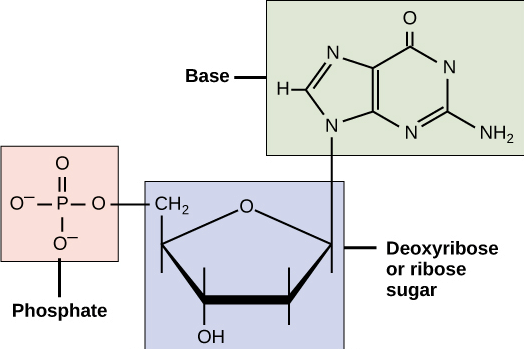
each nucleotide is made up of 3 parts:
- a nitrogenous base
- a five-carbon sugar
- at least one phosphate group
Nitrogenous Base
it’s called a base because the nitrogens can be protonated (pick up an extra H+ ion), which decreases the hydrogen ion concentration in a solution
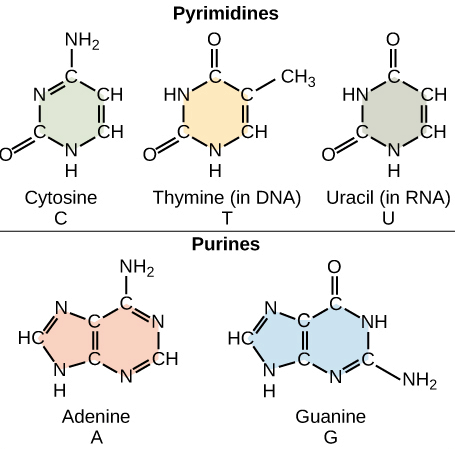
there are 5 possible nitrogenous bases
|
nitrogenous bases |
letter symbol |
purine or pyrimidine |
found in |
|---|---|---|---|
|
adenine |
A |
purine |
DNA & RNA |
|
guanine |
G |
purine |
DNA & RNA |
|
cytosine |
C |
pyrimidine |
DNA & RNA |
|
thymine |
T |
pyrimidine |
DNA only |
|
uracil |
U |
pyrimidine |
RNA only |
Five-Carbon Sugar
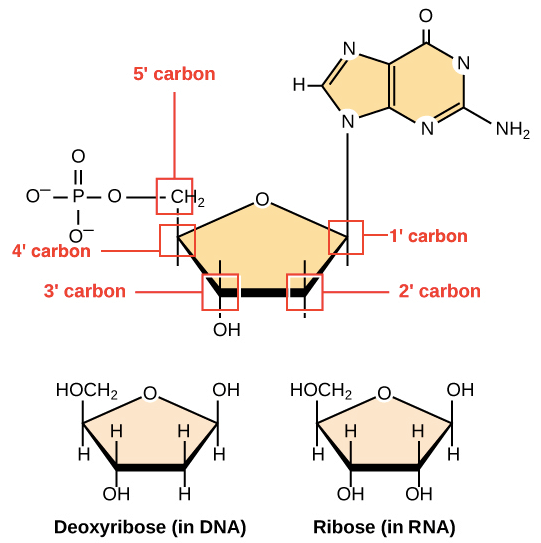
In addition to having slightly different sets of bases, DNA and RNA nucleotides also have slightly different sugars. The five-carbon sugar in DNA is called deoxyribose, while in RNA, the sugar is ribose. These two are very similar in structure, with just one difference: the second carbon of ribose bears a hydroxyl group, while the equivalent carbon of deoxyribose has a hydrogen instead. The carbon atoms of a nucleotide’s sugar molecule are numbered as 1′, 2′, 3′, 4′, and 5′ (1′ is read as “one prime”), as shown in the figure above. In a nucleotide, the sugar occupies a central position, with the base attached to its 1′ carbon and the phosphate group (or groups) attached to its 5′ carbon.
Phosphate Group
Nucleotides may have a single phosphate functional group, or a chain of up to three phosphate groups, attached to the 5’ carbon of the sugar. Some chemistry sources use the term “nucleotide” only for the single-phosphate case, but in molecular biology, the broader definition is generally accepted
In a cell, a nucleotide about to be added to the end of a polynucleotide chain will bear a series of three phosphate groups. When the nucleotide joins the growing DNA or RNA chain, it loses two phosphate groups. So, in a chain of DNA or RNA, each nucleotide has just one phosphate group.